
Pune’s housing market has done something that surprised even seasoned developers — 3 BHK flats are outselling 2 BHKs in several key localities. Not by a little. In some pockets, the gap is wide enough that builders are restructuring upcoming launches to shift the unit mix.
This isn’t a trend. It’s a recalibration. And it’s worth understanding why before you buy.
Why 3 BHK Flats Became Pune’s Default Choice
For years, the 2 BHK was Pune’s reliable bestseller. Affordable entry point, lower maintenance, easier to rent out. That logic held until it didn’t.
Three things changed the calculation
- Remote and hybrid work made an extra room genuinely necessary — not aspirational
- Families that stretched into 2 BHKs a few years ago are now upgrading
- Builders responded by pricing 3 BHK Pune configurations more competitively than before
The result is a segment that now has both demand and supply moving in the same direction.
The Work-from-Home Effect on 3 BHK Demand
This one is real and it’s not going away.
A dedicated room for work stopped being a lifestyle upgrade sometime around 2021. It became a functional requirement. For families with two working adults — which describes a large share of Pune’s buyer profile — a 2 BHK stops working the moment one person needs a call and the other is home.
The third bedroom absorbs that problem. And once buyers experience having it, they don’t want to go back.
Which Localities Are Seeing the Fastest Movement?
Not all parts of Pune are seeing the same pace. The western corridor has been particularly active:
- Baner and Balewadi — proximity to IT hubs with good social infrastructure drives consistent demand
- Wakad — family-friendly, well-connected, and still accessible in pricing
- Undri and NIBM Road — quieter, better possession track records, strong end-user base
- Hinjewadi Phase 3 stretch — newer supply with metro anticipation factored in
Eastern Pune — Kharadi, Wagholi — is also seeing movement, though mostly in the mid-segment.
What 3 BHK Buyers in Pune Check Now?
The configuration matters, but so does what’s inside it. Buyers shortlisting 3 BHK flats in Pune in 2025 are checking:
- Usable area ratio, not just carpet vs built-up numbers
- Natural ventilation in all three rooms, not just the master
- Floor plate design that doesn’t put the kitchen at the entrance
- Lobby and common area quality as a proxy for builder standards
- Parking allocation per unit
The era of buyers ignoring floor plans and focusing only on price per square foot is largely over. At least in this segment.
3 BHK Pune Pricing Across Segments
Ticket sizes vary significantly by locality and project quality
- Affordable 3 BHK: ₹75L to ₹1.1Cr — mostly eastern Pune and emerging corridors
- Mid-segment 3 BHK: ₹1.1Cr to ₹1.8Cr — Wakad, Undri, Baner fringe
- Premium 3 BHK: ₹1.8Cr to ₹3.5Cr — Baner, Balewadi, Kalyani Nagar
The mid-segment is where the volume is happening. It’s also where the quality gap between projects is most visible — a ₹1.4Cr flat from a builder with a clean track record is a genuinely different product from one at the same price from someone with three stalled projects on RERA.
What Sets This Builder Apart in the Segment
Rachana Lifestyle has been building in Pune long enough to know what mid-to-premium 3 BHK buyers actually need versus what looks good in a brochure.
Their approach to floor plate design — usable rooms, natural light in secondary bedrooms, parking ratios that hold up under scrutiny — shows up in how their projects perform post-possession. That’s harder to fake than a rendered walkthrough.
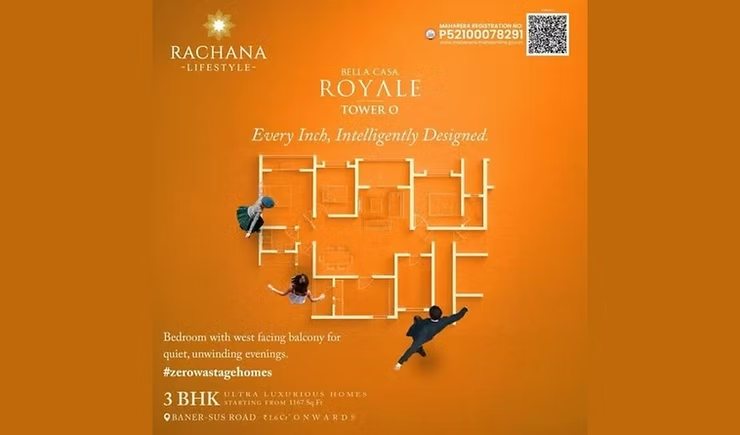
Bella Casa Pune by Rachana Lifestyle is their current residential offering in this segment. Worth a visit if you’re comparing options in Baner’s premium stretch.
The Investment Case for 3 BHK Flats in Pune
Buyers treating this as an investment, not just a home, have a reasonable case.
Three-bedroom units in well-located Pune projects have consistently appreciated faster than 2 BHKs in the same building over the last several cycles. Rental demand is also stronger — corporate relocations, senior professional tenants, and families on assignment all prefer 3 BHKs over 2 BHKs when the price differential is manageable.
The resale story is cleaner too. A 3 BHK from a credible builder in a good Pune locality rarely sits on the market. 2 BHKs in oversupplied pockets can.
What First-Time 3 BHK Buyers Usually Miss?
The checklist most buyers use is fine. The things that aren’t on it
- Maintenance costs post-possession — larger projects with more amenities carry higher society charges. Ask for an estimate before signing.
- Lift-to-unit ratio — in high-rise towers, one lift per hundred flats is a problem you’ll feel daily.
- Builder’s OC history — how long after possession did their last three projects receive Occupancy Certificates?
- Resale restrictions in the first few years — some projects have clauses that aren’t obvious at the booking stage.
- Society formation track record — how quickly do their completed projects form resident welfare associations?
The Finish Quality Difference That Shows Up Later
Most developers compete on amenity count. The builder behind Bella Casa Pune competes on finish quality and building management after handover.
That distinction matters about eighteen months into living in a project. An amenity that works and stays maintained is worth more than ten that are locked by year two.
The Actual Takeaway Before You Book
The demand for 3 BHK flats in Pune is real and it’s coming from end-users, not speculators. That changes the dynamics.
Projects backed by credible builders with clean RERA records and strong OC timelines are seeing bookings move fast — not because of artificial scarcity, but because buyers who’ve done the research know what they’re looking at.
If you’re actively evaluating, the shortlist should be short. Two or three localities, two or three builders with verified track records. Then go deep on those rather than spreading across fifteen projects.
The market has good options. The work is in finding which ones are actually good.