
Ask five people why Pune’s property market keeps climbing and you’ll get five different answers: IT jobs, the metro, cheaper prices than Mumbai, good weather, whatever. Most of them are half right. None of them tell the whole story on their own.
The real answer is duller and more useful: Pune’s growth is driven by people actually needing homes and offices near where they work, not speculation chasing a trend. That distinction matters more than it sounds.
The Numbers Behind the Noise
Start with what actually happened last year. According to CRE Matrix and CREDAI Pune’s January 2026 housing report, the city sold roughly 81,000 homes in CY’25, generating around ₹63,000 crore in transaction value, making it India’s highest-selling housing market for the year. Average home prices reached about ₹78 lakh, up 44% since 2021.
Those aren’t speculative-bubble numbers. A bubble looks like prices spiking while sales volumes fall. Pune’s story is the opposite: volumes and prices climbing together, which usually points to genuine demand rather than flipping activity.
The commercial side backs this up. Cushman & Wakefield’s Q1 2026 Pune MarketBeat report recorded 11,371 residential unit launches for the quarter, an 8.2% year-on-year rise, alongside continued strength in office leasing driven largely by Global Capability Centres. When both residential launches and commercial leasing move up together, it usually means the underlying job market is actually expanding, not just the property listings.
Jobs Came First, Real Estate Followed
This is the part people get backwards. They assume real estate growth creates jobs. In Pune, it’s mostly the reverse.
Hinjewadi alone is often cited as employing more than 400,000 professionals across Asia’s largest IT park. That’s not a rounding error, it’s a small city’s worth of people who need somewhere to live within a reasonable commute. Every housing project, every retail strip, every commercial project in Pune built along that corridor exists because the jobs showed up first.
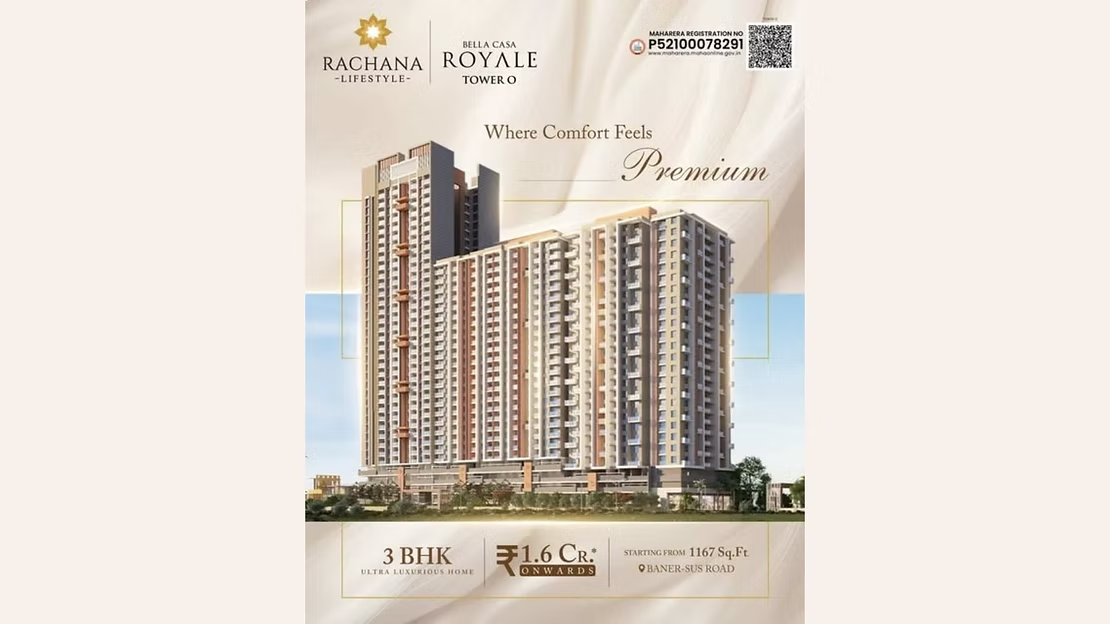
Developers who understood this early, including established names like Rachana Lifespaces, built across both residential and commercial categories rather than betting on one segment. That diversification has aged well, since it means a slowdown in one part of the market doesn’t sink the whole portfolio.
Infrastructure Is Catching Up, Finally
For years, Pune’s biggest complaint wasn’t demand, it was getting around the city. That’s shifting. Pune Metro’s Phase 1 now connects Hinjewadi to major parts of the city, cutting commute times that used to make West Pune a hard sell for anyone without a car.
The proposed Ring Road and the long-discussed Purandar airport are still years from completion, but land values in surrounding belts have already started moving on the announcement alone. That’s a pattern real estate markets show again and again: infrastructure gets priced in well before the concrete gets poured.
Why West Pune Keeps Winning
If you map where the activity is concentrated, West Pune shows up disproportionately often, covering Hinjewadi, Baner, Balewadi, Wakad, and the belt around them. It isn’t the cheapest part of the city. It’s rarely even the most scenic. What it has is proximity: to jobs, to retail, to schools, and increasingly to metro access that didn’t exist five years ago.
That’s a big part of why so much new commercial and residential supply keeps landing in this corridor instead of spreading evenly across the city. Developers follow demand, and demand has been telling them, loudly, where it wants to be.
Is This Growth Sustainable, or Just a Cycle?
It’s a fair question, and the honest answer is: probably more sustainable than Pune’s last boom, but not without risk. Residential registrations actually dipped in early 2026, down 17% year-on-year in January, according to state stamp duty data. That’s not a red flag on its own. Markets that are driven by real buyers rather than investors tend to move in these short pauses rather than crashes, because the demand doesn’t vanish, it just waits for the right unit or the right price.
The bigger risk sits in oversupplied micro-markets where too many launches chase the same buyer pool. That’s a developer-selection problem more than a city-wide one, and it’s exactly why track record and delivery history matter more in Pune right now than they did five years ago.
FAQ’s
Why is Pune considered one of India’s fastest-growing real estate markets?
Pune combines strong end-user demand, rapid IT and manufacturing job growth, and improving infrastructure like the metro, which together support both residential and commercial real estate activity.
Is Pune’s real estate growth driven by investors or actual buyers?
Largely genuine buyers. Reports from CRE Matrix and CREDAI attribute much of the city’s 2025 sales volume to end-user demand rather than speculative investment.
Which parts of Pune are seeing the strongest real estate growth?
West Pune, including Hinjewadi, Baner, Balewadi, and Wakad, continues to lead due to IT employment density and improving metro connectivity.
Are established developers like Rachana Lifespaces active in this growth?
Yes. Developers with a longer track record across both residential and commercial categories have generally been better positioned to capture demand across Pune’s expanding corridors.
The Real Question to Ask Before You Decide
Pune’s growth story isn’t about one dramatic factor, it’s about several ordinary ones lining up at the same time: jobs, roads, and buyers who actually plan to live or work in what they’re buying. If you’re trying to time your own move into this market, the better question isn’t “is Pune growing.” It clearly is. The better question is whether the specific corridor and developer you’re looking at are riding that growth or just borrowing its reputation.